

Instrumentation
About
RSAA has a long history of research and development in astronomical instrumentation, and has constructed a number of precision instruments for our own telescopes, and others around the world. The Advanced Instrumentation Technology Centre (AITC) provides advanced facilities for the instrumentation scientists and engineers of the school, who work on projects in the areas of optics and detector science, integral-field spectroscopy, adaptive-optics technologies, instrumentation for the next generation of ground-based telescopes, and survey astronomy. The AITC is also a unique facilitiy for training instrument science, engineering, and astronomy students.
Astronomical instrumentation
The RSAA has considerable expertise and experience in design and development of advanced instrumentation for astronomy. The school has completed two instruments for the twin 8m telescopes of the Gemini Observatory: the Near-infrared Integral-Field Spectrometer (NIFS) and Gemini South Adaptive Optics Imager (GSAOI), in addition to instrumentation for the facilties of MSO: such as the Dual-Beam Spectrograph (DBS), and Wide-Field Spectrograph (WiFeS) instruments for ANU 2.3m Telescope (also built largely in house), and the wide-field, 238 megapixel SkyMapper camera.
The technical program has particular expertise in optical and infrared spectroscopy, integral-field spectroscopy, adaptive optics, and wide-field imaging.
Adaptive optics
The school has built a core of expertise in the field of adaptive optics (AO), a technology that will be essential to the success of high-resolution observations with the next generation of large ground-based telescopes. AO systems correct for the effects of turbulence in the air of the atmosphere, which causes distortion to the images produced by telescopes on the Earth. RSAA AO scientists are working with industy partners to develop the technologies and techniques required to extend AO capabilities to greater efficacy and for use with extremely-large telescopes (ELTs) such as the Giant Magellan Telescope (GMT).
The Giant Magellan Telescope
ANU is leading Australia's involvement as a member of the international consortium that will design, build, and use the Giant Magellan Telescope. This facility will have an effective mirror aperture of 24.5m and is scheduled for completion in around 2020. RSAA is building one of the first instruments that will be used with the telescope, the GMT Integral-Field Spectrograph (GMTIFS) and developing adaptive-optics solutions for the project. Our participation ensures that Australian astronomers and students will continue to have access to cutting-edge resources and provides important opportunities for work on advanced instrumentation applications and astronomical research.
Space and satellite applications
The AITC has been designed to be a world-class facility for developing and testing small satellites and space payloads, in addition to astronomical instrumentation. In this capacity it is fast becoming a national hub for Australia's space community, linking industy to researchers and aerospace projects around the world.
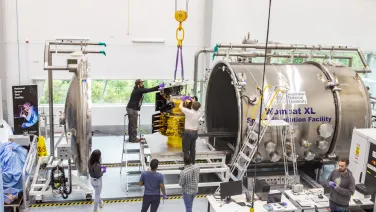
The space research facilities at RSAA will include a large thermal vacuum test chamber to simulate the space environment, a vibration test facility capable of exerting acceleration forces of several tons on instruments under test, and a small satellite groundstation that was installed as part of the Antarctic Broadband project.
Collaboration with industry
Our scientists and engineers have a history of industry partnership that dates back to Second World War, when they worked in a successful collaboration with the US to produce specialised optics for the war effort. The school continues to foster close links with government, business and research institutions around the world.
Currently, our technical team is working with industy and research partners on projects to develop a satellite system for monitoring greenhouse gases, satellite laser ranging technologies, and a new plasma thruster engine for space travel.
Projects
Members
Academic

Instrumentation Scientist
Advanced Instrumentation Technology Centre

Instrumentation scientist
Advanced Instrumentation Technology Centre
Associate Dean, College of Science
Student

PhD Student
Professional
Lead, Detector, Electronics and Controls
Advanced Instrumentation Technology Centre

Software Specialist
News
Congratulations to Space Machines Company, with the launch of their Optimus satellite!

The MAVIS team had its first busy week with members of the MAVIS consortium from Australian and European teams since the start of COVID.

What does a job in the space industry look like? The Space Careers Wayfinder program is a collaboration between the CSIRO and the Australian National University (ANU) that aims to inspire and ignite a passion in the next generation to foster the growth of the future space industry workforce.

ANU will play a major role in the Taipan galaxy survey, which will for the first time measure the current expansion rate of the Universe with one per cent precision.

To enhance Australia's defence capability by building industrial capability in sensor and on-board data processing for drones and small satellites.

Indigenous- focused daylong Astronomy for regional school students in years 7 to 12.