
Deep-Space & Lunar Optical Communications
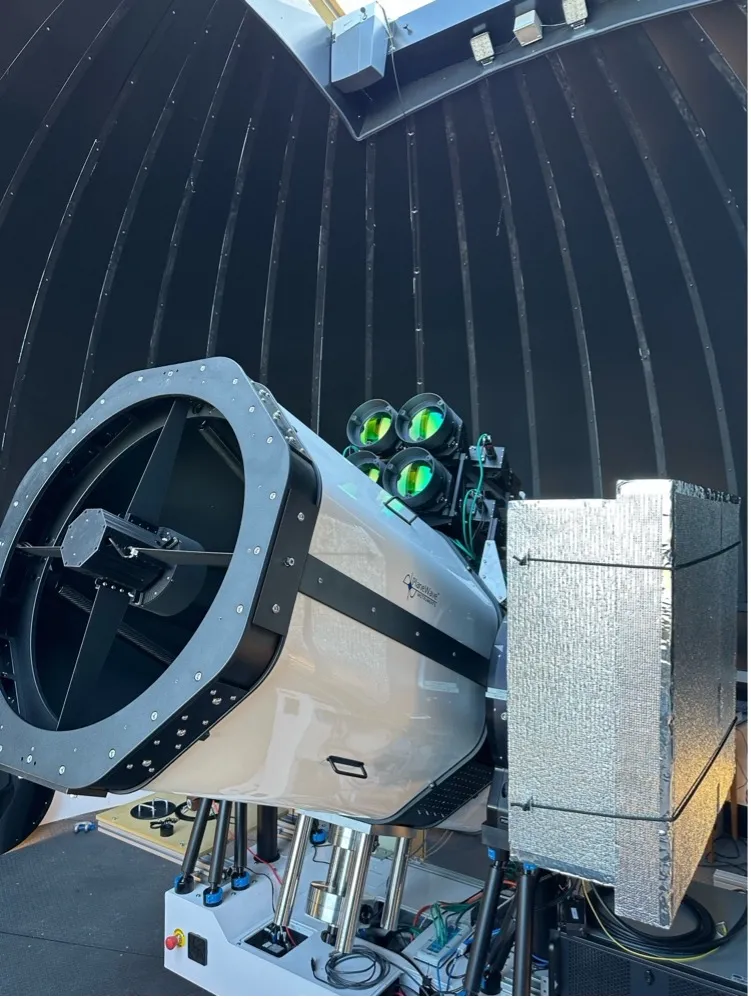
This project supports the development, upgrade, and operation of the ANU Quantum Optical Ground Station (QOGS) to enable an Australian deep-space optical ground station for engagement with international missions including NASA’s Artemis II.
Research themes
Project status
Content navigation
About
RSAA Laser Communication Program
The RSAA Laser Communication Program is a translational research effort that adapts cutting-edge astronomy technologies for space and terrestrial communication applications. Our work spans adaptive optics, high-power lasers, quantum and classical optical communication, advanced detectors, and large telescope systems. Students joining the program will be embedded in a fast-paced, collaborative research environment working on nationally and internationally significant projects.
This project supports the development, upgrade, and operation of the ANU Quantum Optical Ground Station (QOGS) to enable an Australian deep-space optical ground station for engagement with international missions including NASA’s Artemis II. This represents one of Australia’s most significant potential contributions to a crewed NASA mission since the Apollo space flight era.
ANU operates and maintains the 4 m AAT at the Siding Spring Observatory. This large aperture provides an opportunity for Australia to develop and deploy the capability to support long-range optical communications throughout the solar system.
Project Focus
Students will contribute to the design, operation, and prototyping of laser communication systems capable of transmitting and receiving signals to and from missions at lunar distances and beyond, supporting crewed and scientific missions.
Activities May Include
- Prototyping advanced optical transmit/receive systems for lunar and deep-space laser communication
- Developing fibre-optic, electronic, and timing infrastructure
- Link budget analysis and system simulations under realistic mission scenarios
- Supporting integration and operations of an optical ground station
- Working on plans to integrate optical communications to support future AAT activities
Skills & Backgrounds
- Optical and mechanical design
- Electronics and fibre-optic systems
- Systems engineering and simulation
- FPGA programming and high-speed signal processing
- Lasers, modulators, and single-photon detectors
- Telescopes, tracking systems, and observatory operations
Members
Supervisor

Optical Physicist
Advanced Instrumentation Technology Centre

Instrumentation Scientist
Advanced Instrumentation Technology Centre

Instrumentation Scientist
Advanced Instrumentation Technology Centre

Instrumentation Scientist
Advanced Instrumentation Technology Centre

Instrumentation scientist
Advanced Instrumentation Technology Centre
Associate Dean, College of Science