

The evolution of thin and thick discs structures through cosmic time
While it has long been known that the Milky Way ‘thick disc’ is made of older stars - the open question remains as to the origin of thick discs. Suspects include mergers, a turbulent origin via elevated accretion and star formation rates, or gradual dynamical heating. If disc dichotomy (thin + thick disc) is a true feature of galaxy formation, as recent JWST data indicates, then the structures that we see today must be linked to a common feature in their history. This project aims at understanding the causality behind the transition between thick and thin disc regimes.
Research themes
Project status
Content navigation
About
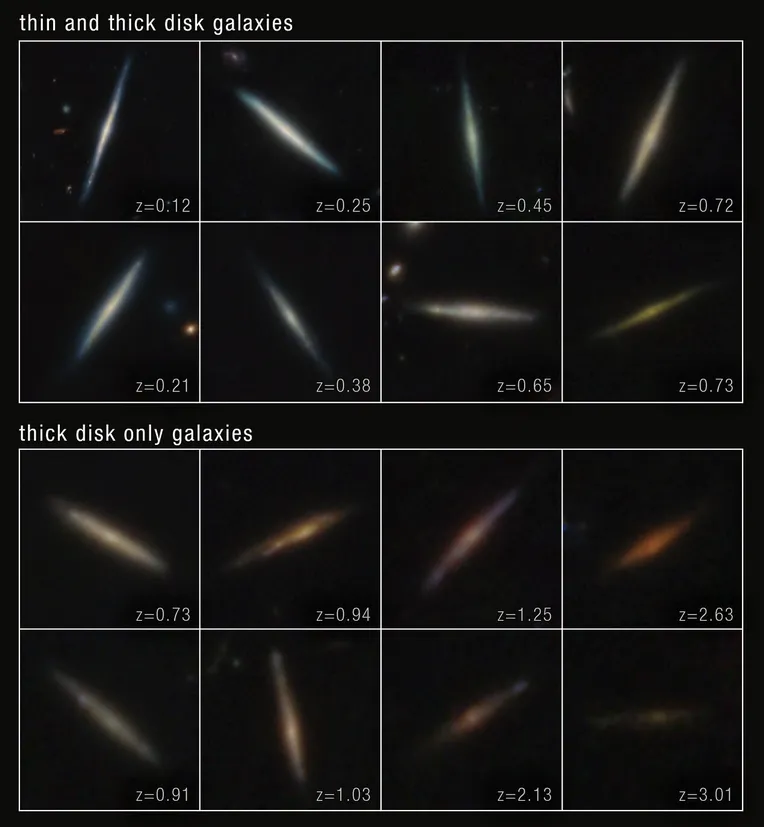
The age and metallicity of stars in the Milky Way reveal the existence of multiple disc structures, now known to be common throughout the local universe. While it has long been known that the Milky Way ‘thick disc’ is made of older stars - the open question remains as to the origin of thick discs. Suspects include mergers, a turbulent origin via elevated accretion and star formation rates, or gradual dynamical heating. Observations and simulations covering ~11 Gyrs from z~3 to z~0 have shown that gas discs were more turbulent at early times suggestive of a turbulent youth. However, some massive cold thin discs have been found at even earlier times complicating this picture. While progress has been made through statistical kinematic samples and deep ALMA data in dissecting the drivers of disc growth, it is with new JWST images that some clarity has emerged. Recently JWST has shown that thick stellar discs are in place early, and later support thin stellar disc growth. Thin discs can form as early as 11 Gyrs ago in the most massive galaxies. If disc dichotomy (thin + thick disc) is a true feature of galaxy formation, as recent data indicates, then the structures that we see today must be linked to a common feature in their history. This project aims at understanding the causality behind the transition between these different formation regimes using JWST data, state-of-the-art cosmological simulations, and developing bespoke chemical evolution models.
In this project, the student would (1) become familiar with extracting morphological information from JWST imaging and grism data using published tools, (2) develop analytic models to explore the chemical evolution in thick and thin discs, (3) utilise statistical datasets from simulations to link the chemistry and morphology of discs. The student taking on this project is expected to familiarise themselves with the basic principles of image deconvolution, grism spectroscopy, and galaxy evolution models. This project will be in collaboration with researchers at the ANU, UWA, and IPMU (Tokyo).
Members
Supervisor

Astronomer
Research School of Astronomy and Astrophysics