
How scientists used lasers to communicate with Artemis II on their moon mission
Publication date
Monday, 5 Oct 2026
Body
How scientists used lasers to communicate with Artemis II on their moon mission
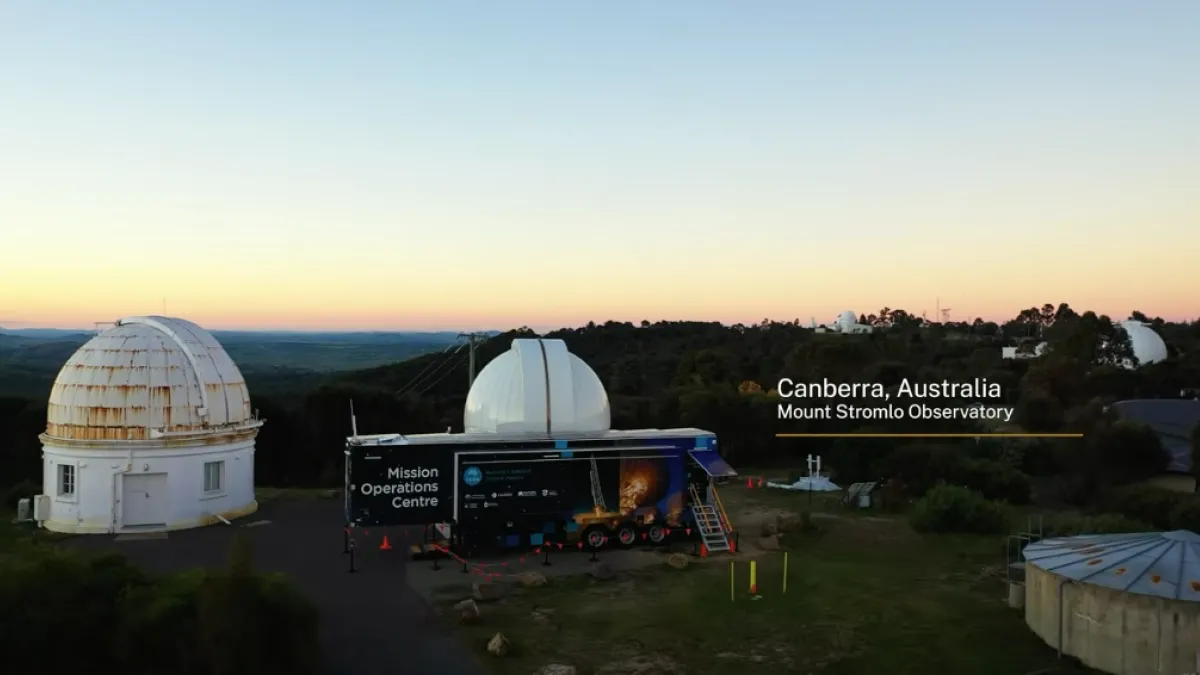
When Artemis II left Earth in April 2026 in search of the dark side of the Moon, Professor Francis Bennet and his team waited anxiously at Mount Stromlo Observatory, ready to test their new optical communication system.
With stunning photographs and 4K video to transmit all the way back to ground control, the crew on the Orion spacecraft needed an exceptionally fast data connection which traditional radio communication couldn’t provide.
Up on the mountain, the Canberra team were poised to see if the ANU Quantum Optical Ground Station was up to the task as a Southern Hemisphere connection for future space missions.
Go behind the scenes as the ANU Quantum Optical Ground Station team connected to the Orion spacecraft on its journey around the Moon, providing fast and secure laser optical communication.
Located within the ANU Research School of Astronomy and Astrophysics, the ANU Quantum Optical Ground Station is supported by the Australian Space Agency and was established with funding from the ACT Government, CSIRO and the ANU Institute for Space.
Stay tuned to watch the full story of the QOGS and the Artemis II Mission in a feature documentary coming soon with ANU InSpace. How the humble team on Mount Stromlo became a crucial link for the NASA mission.
Images and livestream footage credit: NASA