Detecting Cosmic Dawn with Precision Radio Astronomy
When did the first stars and galaxies form? This project will help commission and deploy the world’s most precise radiometer and a purpose-built antenna to search for the elusive global 21-cm signal from Cosmic Dawn, one of the foremost challenges in observational cosmology. Working with researchers at ANU and CSIRO, the student will combine instrumentation, field observations, Bayesian data analysis and astrophysical modelling to detect—or place new constraints on—the signature of the first stars in the early Universe.
Research themes
Project status
Content navigation
About
When did the first stars and galaxies form? This question lies at the heart of modern astrophysics. As the first stars ignited during Cosmic Dawn, they altered the thermal and ionisation state of neutral hydrogen throughout the Universe, leaving an extremely faint imprint on the low-frequency radio sky. Detecting this global 21-cm signal would provide an unprecedented window into the formation of the first stars and galaxies, and the subsequent evolution of the Universe.
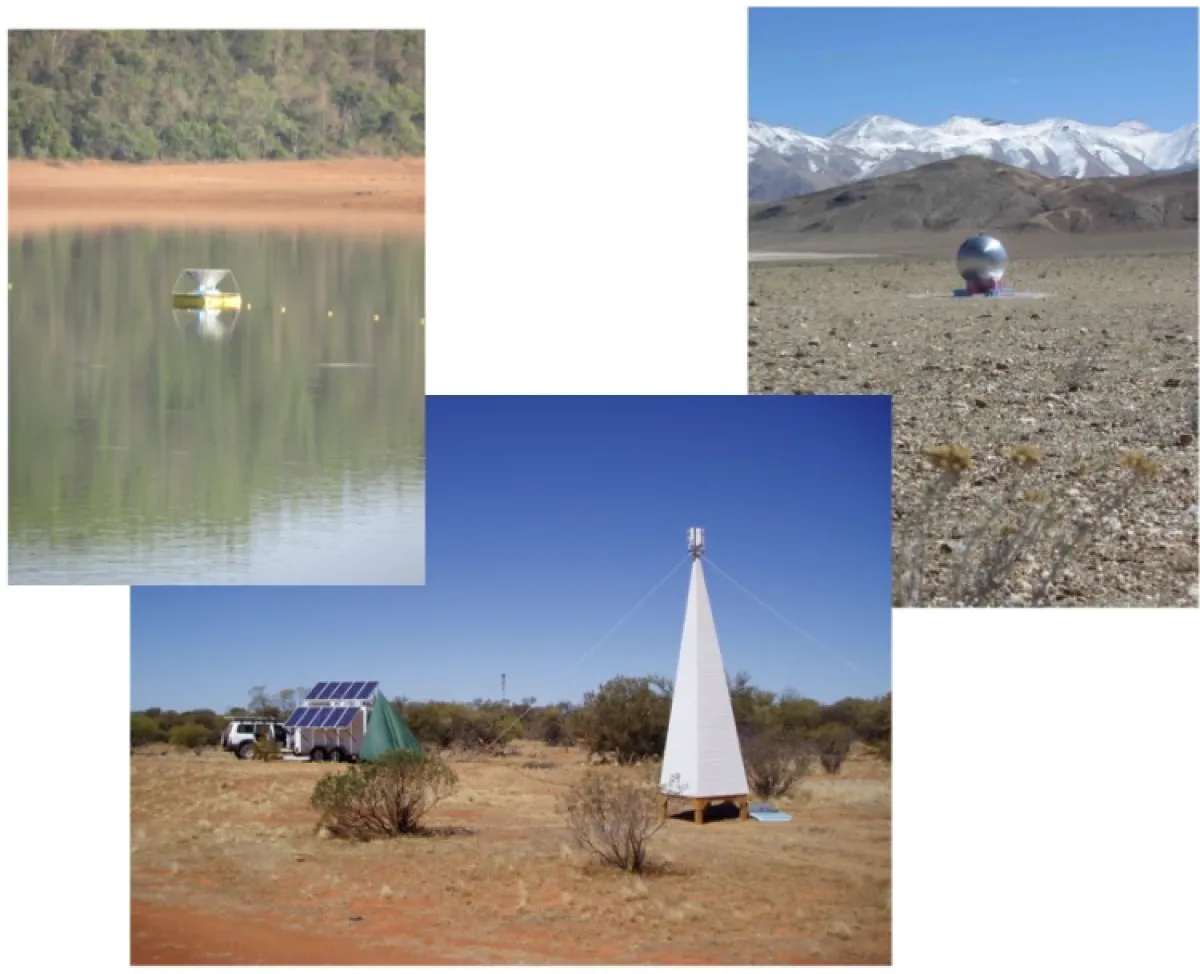
This project centres on commissioning and using the world’s most precise radiometer together with a purpose-built antenna, developed through a collaboration between ANU and CSIRO. Professor Emeritus Ravi Subrahmanyan has developed a world-leading ultra-precision radiometer and co-developed a uniquely calibrated antenna designed specifically to overcome many of the systematic calibration challenges that have limited previous experiments. The instrument represents a significant advance towards detecting the global 21-cm signal from Cosmic Dawn.
The student will play a leading role in commissioning the instrument, deploying it at radio-quiet observing sites across Australia in a field-work context, acquiring observations of the global radio sky, and analysing the resulting data using modern Bayesian statistical techniques. The project will also include modelling the antenna response and instrumental performance, comparing observations with theoretical models of Cosmic Dawn and the Epoch of Reionisation, and making new measurements of the global 21-cm signal or placing improved constraints on the timing and physics of the first stars.
The project is jointly supervised by Professor Emeritus Ravi Subrahmanyan (ANU) and Dr Craig Anderson (ANU), in collaboration with researchers from CSIRO including Dr Aaron Chippendale. Students will work across ANU and CSIRO, with opportunities to travel between Canberra and Sydney and participate in observing campaigns at remote Australian radio-quiet sites.
The project builds on a series of recent Nature Astronomy publications by members of the team and forms part of the next phase of the GINAN programme, with future developments extending towards GINAN-Space, an Australia-led mission concept for precision measurements from lunar orbit. The programme offers the opportunity to contribute to research at the forefront of experimental cosmology, with the expectation of producing further internationally significant scientific outcomes.
Recent high-impact publications from the team include:
* https://www.nature.com/articles/s41550-026-02888-5
* https://www.nature.com/articles/s41550-022-01825-6
* https://www.nature.com/articles/s41550-022-01610-5
Ideal background: Physics, astronomy, electrical engineering, computer science, or a related discipline. Students with interests in instrumentation, signal processing, data analysis, radio astronomy or cosmology are particularly encouraged to apply. A current driver’s licence, and a willingness to travel between ANU in Canberra and CSIRO in Sydney (Marsfield), as well as participate in field deployments at remote Australian observing sites, is highly desirable.
Members
Supervisor

Postdoctoral Fellow
Research School of Astronomy and Astrophsyics
Partners & sponsors