
Characterising satellite RFI and its impact on radio astronomy and 21cm cosmology
This project aims to use near-field imaging techniques to understand the impact of satellite radio-frequency interference (RFI) on radio interferometric observations and develop strategies for its mitigation.
Research themes
Project status
Content navigation
About
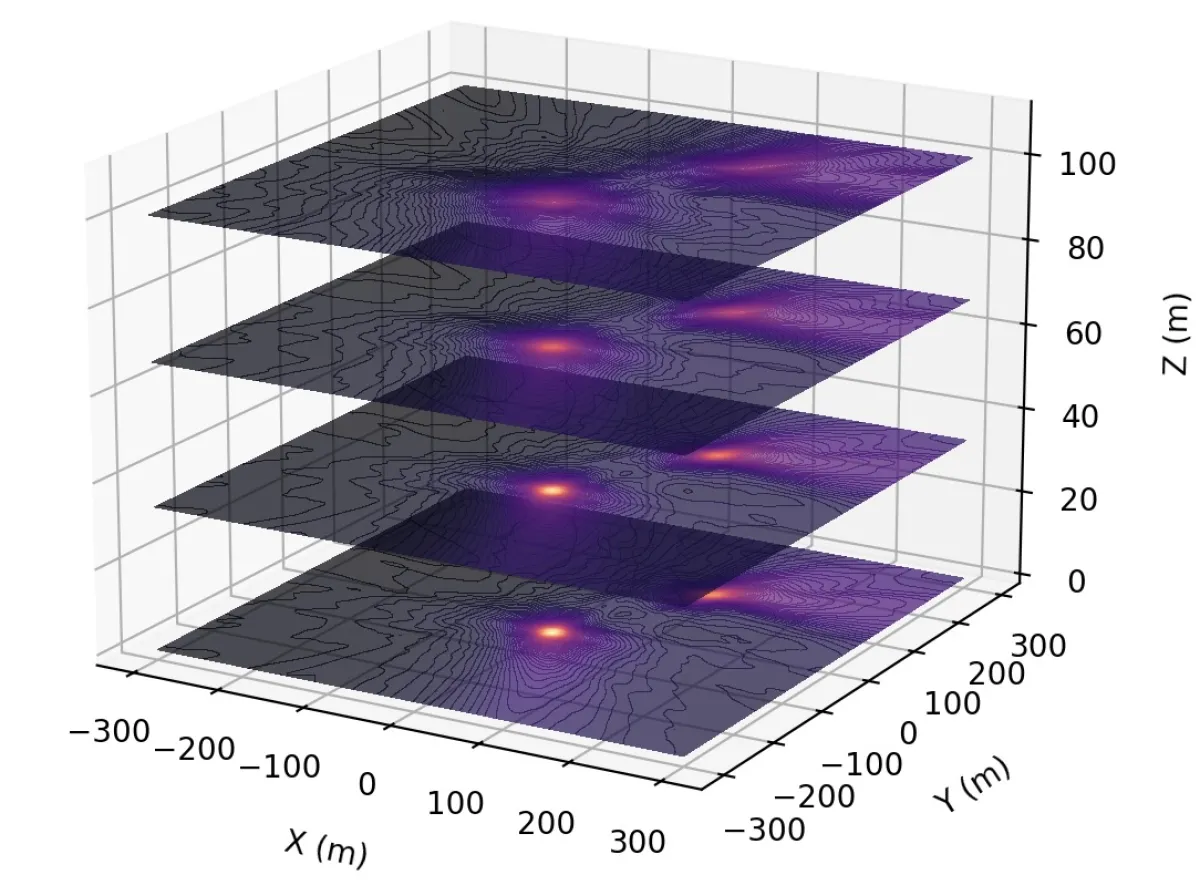
One of the most pressing challenges facing modern radio astronomy is the rapid growth of satellite constellations in low-Earth orbit. These satellites produce unintended radio-frequency interference (RFI) that contaminates observed data, reducing the sensitivity of radio telescopes to faint cosmic signals. This is particularly problematic for 21-cm cosmology, which seeks to detect the extremely weak radio emission from neutral hydrogen during the early Universe.
Unlike astronomical sources, satellites in low-Earth orbit lie in the near-field regime of radio interferometers, meaning their signals cannot be accurately described using the conventional plane-wave approximation. Instead, their effects must be modelled using spherical-wave propagation. Recent advances in near-field imaging and RFI modelling have made it possible to identify and characterise such sources directly from interferometric data.
In this project, the student will use state-of-the-art techniques, including TABASCAL (https://arxiv.org/abs/2301.04188) and NFIS (https://arxiv.org/abs/2503.21728), to model and image satellite RFI in both real and simulated observations. The project will combine data analysis, simulations, and algorithm development to assess the impact of satellite contamination and explore mitigation strategies for current and future radio telescopes.
The project has the following objectives:
1. Apply near-field imaging techniques to observations from the Murchison Widefield Array (MWA) and evaluate their performance on real data.
2. Quantify the impact of satellite RFI on 21-cm cosmology observations using simulated observations of the Square Kilometre Array.
3. Develop algorithms to efficiently flag, or subtract satellite RFI contamination from radio interferometric data.