

Building a survey to resolve galaxies in the disk settling era
How do we build impactful astronomical surveys? MAVIS will be the world's first facility-grade visible multi conjugate adaptive optics instrument providing high resolution imaging and spectroscopy in optical wavebands. A primary science goal of MAVIS is to determine what physical drivers lead to the emergence of thin, high angular momentum disk galaxies in the epoch from z~0.4 to z~1.0. Now is the time to plan these future observations using in-house built tools to simulate realistic observations with MAVIS and the time needed to execute them.
Research themes
Project status
Content navigation
About
How do we build impactful astronomical surveys?
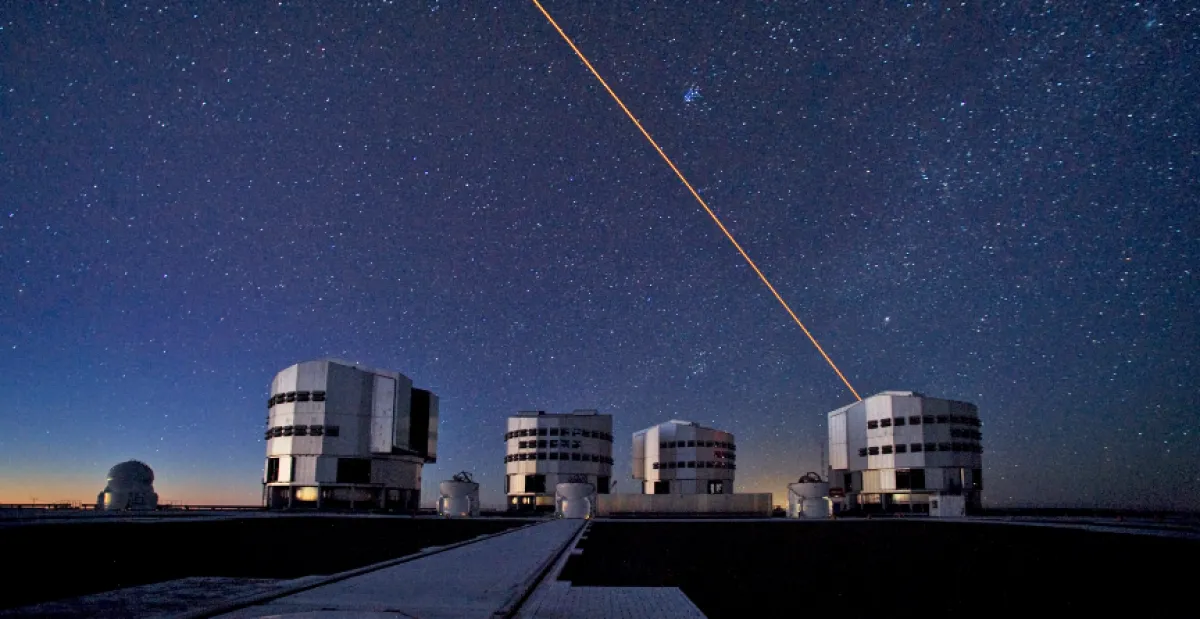
The MCAO-Assisted Visible Imager and Spectrograph (MAVIS) instrument for the Very Large Telescope in Chile is being built here at RSAA-AITC. MAVIS will be the world's first facility-grade visible multi conjugate adaptive optics (MCAO) instrument providing high resolution imaging and spectroscopy in optical wavebands. With its combination of high spatial and spectral resolutions, MAVIS provides a unique opportunity to trace evolution of the ISM during a critical time in the history of the universe to uncover the mechanisms driving the evolution of disk galaxies over the last 8 billion years.
A primary science goal of MAVIS is to determine what physical drivers lead to the emergence of thin, high angular momentum disk galaxies in the epoch from z~0.4 to z~1.0. Now is the time to plan these future observations, taking into account the dynamic galaxy evolution field with new results from many multi-wavelength facilities including the James Webb Space Telescope and the Atacama Large Millimetre Array. Tools have been built at the RSAA to simulation realistic observations with MAVIS and the time needed to execute them.
In this project the student would (1) become familiar with the MAVIS instrument and it's capabilities (2) work with large datasets and archival catalogs to identify potential targets for MAVIS observations (3) simulate observations with the MAVIS simulator to help design future surveys.
The student taking on this project is expected to familiarise themselves with the basic principles of emission-line measurements, integral field spectroscopy, and exposure time calculations.
This project will be in collaboration with Dr. Melanie Kaasinen and Dr. Trevor Mendel (deputy PI of MAVIS).
Members
Supervisor

Astronomer
Research School of Astronomy and Astrophysics
Collaborator

DECRA Fellow and Senior Lecturer
Research School of Astronomy and Astrophysics

Astronomer
Research School of Astronomy and Astrophysics
Advanced Instrumentation Technology Centre