Standard sirens, their progenitor properties and host galaxy environments
This project will investigate the properties of binary neutron star progenitors and their host galaxies by applying state‑of‑the‑art transient modelling tools. By linking the astrophysical properties to their explosive counterparts, we will have a better idea of what types of sources will produce kilonovae. A deeper understanding of this astrophysics is essential for optimising future electromagnetic follow‑up strategies for gravitational‑wave detections.
Research themes
Project status
Content navigation
About
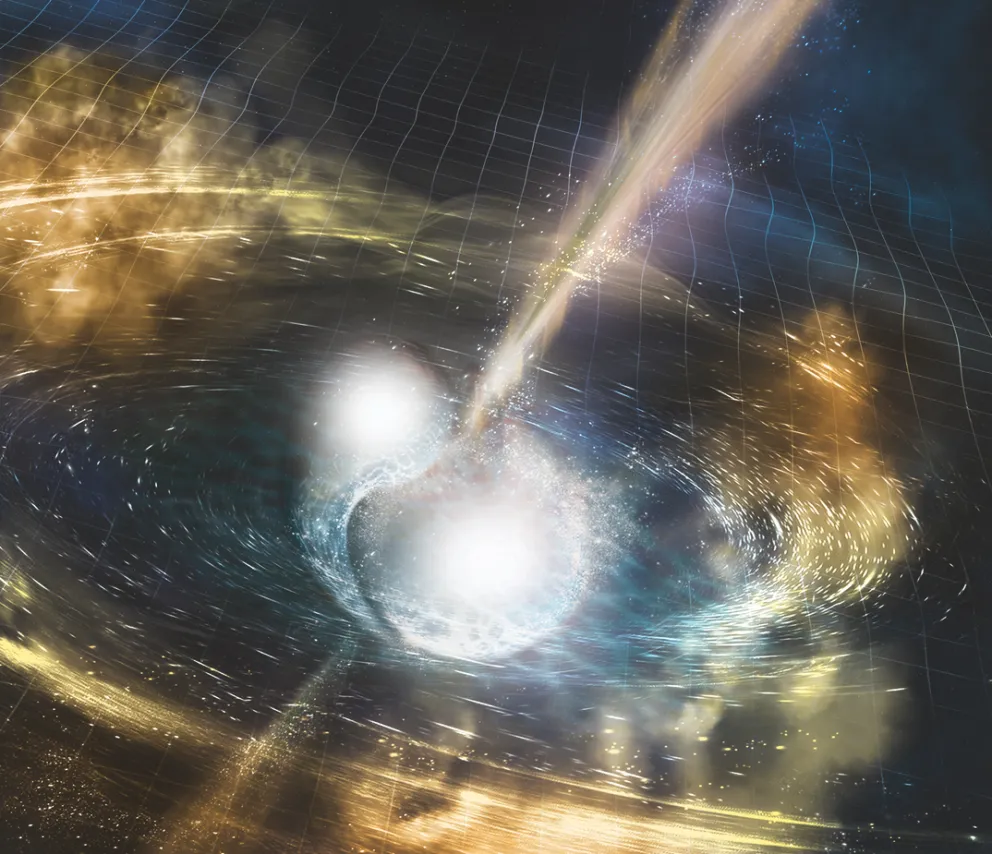
In 2017, LIGO-Virgo and multi-messenger teams made the first detection of gravitational waves and light from a pair of in-spiralling neutron stars, now known as GW170817 (Abbott et al. 2017). Electromagnetic emission from the resulting collision was observed from the gamma-ray to radio, providing insights into long-standing questions such as the origin of short gamma-ray bursts and the origin of heavy elements. It was the first and still only time we had directly observed a kilonova emission, AT2017gfo, associated with the ejecta resulting from the final coalescence of binary neutron stars. To improve our search for kilonovae, we need a better understanding of how and where they form.
For this project, we will be doing the following:
1. Generating a catalogue of synthetic astrophysical observables with Synthesizer.
2. Use Redback to get lightcurves for these objects.
3. Compare these to GW170817.
4. Analyse if there is any correlation between the probability of producing a kilonova and the progenitor properties.
5. We can extend this to cross match to galaxy catalogues and see what type of environments we could find these kilonovae.
The project is open ended and students are more than welcome to contact me to discuss how to adjust the project to cater to their interests and goals.
Members
Supervisor

Postdoctoral Researcher
Partners & sponsors